
Building Code Updates Are Changing Warehouse Rack Design
What Distributors Need to Know
The warehouse storage industry is navigating one of the most significant changes to rack design in decades.
The 2021 edition of the ANSI/RMI MH16.1 standard (Design, Testing, and Utilization of Industrial Steel Storage Racks) replaced the effective length method with the direct analysis method. 2026 has seen rapid expansion in the adoption of the 2024 IBC, which incorporates MH16.1:2021.
The effective length method is a traditional design approach for evaluating the stability of a steel frame. With this method, calculating the buckling capacity of the column involves multiplying the unbraced length of the column (the distance between beams for the down-aisle direction, for example) by an effective length factor (K).
The direct analysis method is a newer, more accurate approach which evaluates stability through a rigorous analysis which directly accounts for second-order effects rather than estimating them. For distributors, understanding these changes, and helping customers navigate them, will become increasingly important over the coming years.
What are Second-Order Effects?
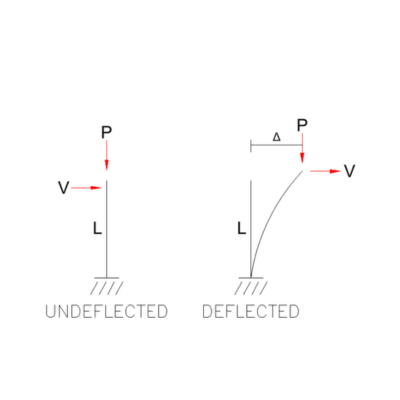
Structures deflect or displace under load, and these deformations can result in that initial load inducing further stress and displacement on the structure. If the structure is stable, these second-order effects will be small enough that they will not continue to amplify. Unstable structures can see larger second-order effects that amplify, resulting in larger stresses and displacements, eventually leading to collapse.
Steel Storage Racks which withstand heavy loading can be made very tall from relatively thin materials, which makes them very efficient. This efficiency also makes them stability-sensitive structures.
Accurately accounting for second-order (or P-delta) effects requires a comprehensive system-based design approach, including the following inputs:
- Full Bay Configuration (i.e. All Beam Locations within a Bay)
- Maximum & Average Shelf Loading
- Beam Size
- Beam-to-Column Connector Size
- Base Plate Size & Anchor Arrangement
- Initial Out-of-Plumbness (notional loading)
- Seismic Parameters
What Changes Should We Expect?
Designs per MH16.1:2021 may increase overall system costs by approximately 10–15%, although the impact will vary based on the configuration and seismic design parameters.
By minimizing the second-order effects, we can minimize the cost impact of this new design approach.
The most economical ways to optimize designs to minimize second-order effects are typically:
- Increasing the Beam-to-Column Connector Size
- Increasing Base Plate Size
- Anchor Arrangement (Increased Quantity & Spacing)
- Average Shelf Loading
“The goal of delivering high-quality, safe rack systems has not changed. What is changing is the methodology required to evaluate those systems. As jurisdictions adopt the 2024 IBC at varying rates, clear communication of design requirements becomes more important than ever. The more we know during the quote phase, the better we can equip our distributors with designs that meet code requirements to avoid surprises later.”
— Bill Roney, P.E., Vice President of Engineering, Speedrack Products Group

The Challenge: Code Adoption Isn't Uniform
While adoption of the 2024 IBC is accelerating, many states, counties, and municipalities continue to operate under the 2021, 2018, 2015, or even 2012 IBC (which all reference the 2012 edition of the ANSI/RMI MH16.1 standard).
That means two projects in neighboring jurisdictions could require different versions of the IBC, and therefore different design approaches.
Because building code adoption occurs independently by each Authority Having Jurisdiction (AHJ), the only way to have confirmation is to contact the AHJ directly.
In many cases, that can prove difficult because:
- The project location has not yet been finalized, so the AHJ cannot be determined.
- Quotation phase information is often based on the nearest metropolitan area.
- Even if the project location is known at the quote phase, the end-user may not be ready to announce a project and therefore may not want the AHJ to be contacted.
- Websites for the AHJ may be unclear or out of date.
- The applicable code could also change before the permit is submitted.
What This Means for Distributors
For distributors, this makes having the right information at the beginning of a project more important than ever.
At Speedrack, we’ve added the required building code edition to our quotation process, so projects can be engineered to the applicable codes from the quote phase on.
When requesting a quotation, distributors should identify the expected code edition whenever possible. If the governing code is unknown, we will work with you to evaluate the available options.
Option 1: Design to the Latest Standard
You have the option to design under ANSI/RMI MH16.1:2021 even if the AHJ has not yet adopted the 2024 IBC.
Potential advantages include:
- Superior design methodology
- Reduces the risk of redesign if the jurisdiction adopts the 2024 IBC before permitting
- Improved long-term compliance and increased flexibility for future rack add-ons or modifications
Potential tradeoffs include:
- Higher initial project cost
- Possible reductions in achievable load capacities in certain applications
- Potentially uncompetitive against bids based upon older editions of the standard
- Larger components and/or anchor bolts within the bay footprint
Option 2: Design to the Applicable Standard
If the project location and applicable code have been confirmed by the AHJ, this is typically the best approach. Proper clarifications should be included in your proposal in the event that AHJ requirements change prior to permit submittal.
Every project should be evaluated individually.
How Speedrack is Supporting Our Distributors
As the industry transitions to the new design methodology, there won’t always be a simple answer to which standard should be used. Code adoption varies by jurisdiction, project timelines can stretch across code cycles, and decisions made during the quoting phase can have a significant impact on design, cost, and schedule.
Navigating that transition will require close coordination between distributors, customers, and our engineering team. The earlier we understand the project requirements, the better positioned we are to evaluate the options and identify potential issues before they affect the project.
This is where the strength of our partnership matters.
You know your customers, their projects, their budgets, and their timelines. We bring engineering expertise to help determine what those requirements mean for the rack design. Together, we can evaluate the options, identify potential issues, and make informed decisions before they become challenges later in the project.
And while RMI provides guidance on which standard should be used, the final decision ultimately rests with the Authority Having Jurisdiction.
“The RMI recommends the use of the current edition of the RMI standard in all cases, but ultimately it is up to the individual AHJ to specify the applicable standards. We have seen calculations per the latest RMI standard rejected by AHJs that are on older editions of the IBC, so obtaining early confirmation on design requirements is key. As the code evolves, we are committed to being a trusted partner with you on every project.”
— Bill Roney, P.E., Vice President of Engineering, Speedrack Products Group